Gravity, Time, and Character: Why Unlevel Floors Don’t Mean Your Historic Home is Falling Down
Aging in a historic home is a mark of character, not structural failure. Just as our bodies change over time—our posture shifts, our joints adapt, and we occasionally lean on a cane—a historic house gracefully responds to the passage of decades and centuries.
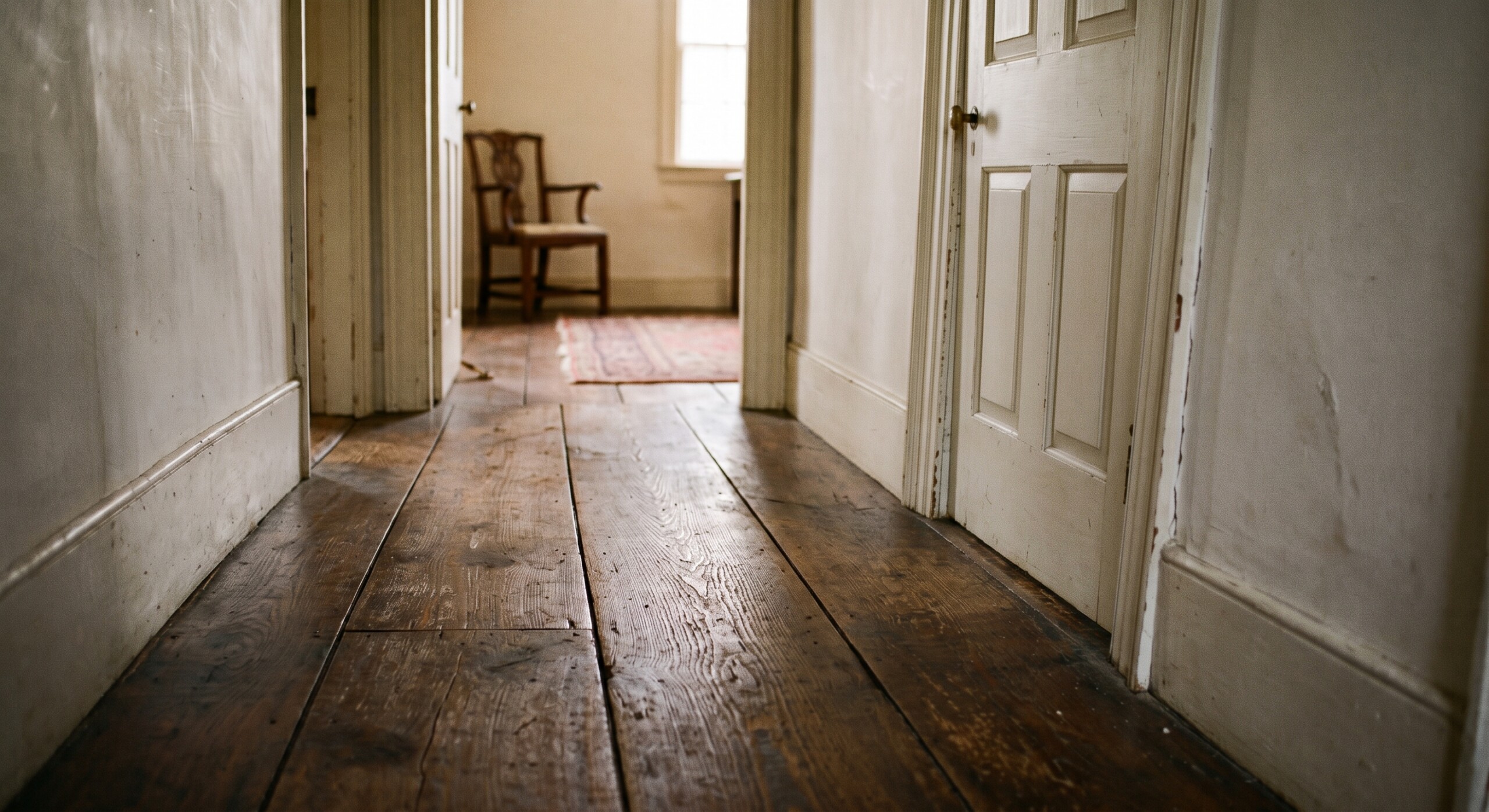
If you’ve ever walked through a 150-year-old home and felt like you were walking slightly uphill—or watched a marble roll across a hardwood floor—you’ve experienced the subtle conversation between gravity and time.
For first-time historic home buyers, a dipping floor or a slightly sloped doorway can spark immediate panic. But here is a secret every historic home lover learns: uneven doesn’t mean unstable.
Gravity Always Plays the Long Game
When an old house settles, it rarely means the foundation is failing or the structural integrity is compromised. More often, it simply means that over a century or two, gravity proved just a little bit stronger than the natural materials. Timbers flex under load, soil shifts subtly with the seasons, and wood naturally breathes and settles into place over generations.
Think of it like human aging. As the years pass, our posture slumps a bit. We lose a fraction of an inch in height, and our spine compressed under a lifetime of living. It doesn’t mean we are broken—it just means we’ve lived a full life.
Enter the Basement “Cane”
When an aging house needs a little extra structural help to stay comfortable, we do what any sensible person does when their knees need support: we give it a cane.
In historic homes, these “canes” take the form of supplemental posts, lally columns, or heavy timber supports added to the basement, cellar, or crawl space. Adding a post beneath a center beam or a heavy joist isn’t a emergency patch job; it’s standard, thoughtful stewardship. It relieves the burden on older framing, prevents further sagging, and keeps the home standing strong for another century.
Embracing the Patina of Time
New construction promises laser-straight 90-degree angles and dead-level subfloors. But historic homes offer something far richer: a physical record of time.
The slight wave in a original wide-plank pine floor or the soft tilt of a doorway isn’t a defect—it’s the home’s unique signature. As long as the foundation is sound and the load-bearing supports are doing their job (sometimes with a little help from below), those subtle slopes are just proof that the house has stood the test of time, weather, and history.
So the next time you feel a slight dip in an old floor, don’t worry. Just admire the grace with which the old house has carried its weight for generations.