The Suspended Canvas: What a Forgotten 19th-Century Rail Teaches Us About Human Attention
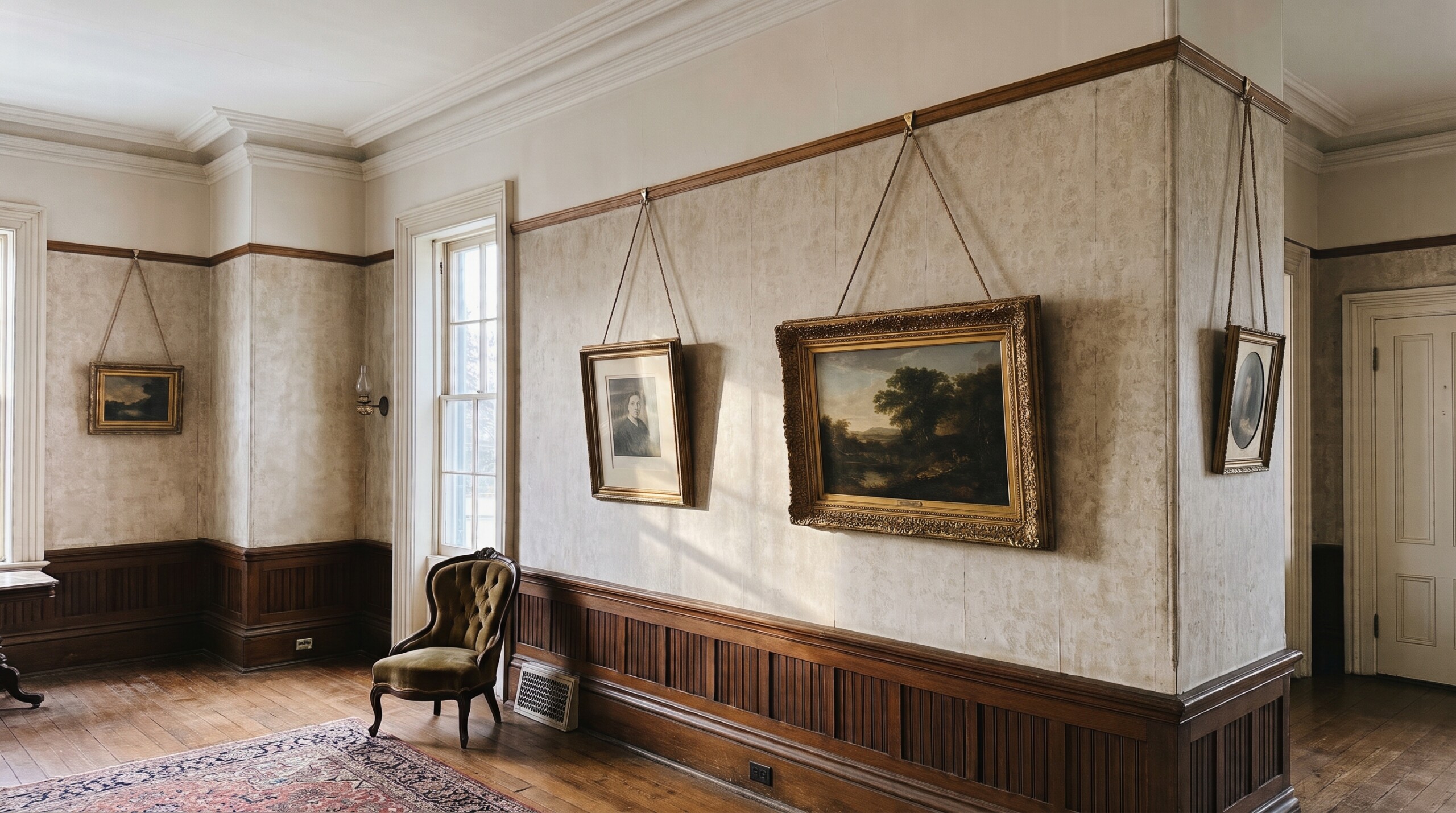
When you spend decades walking inside historic homes—feeling the solid weight of timber-framed sills, studying hand-troweled lime plaster, or watching late afternoon sun streak across original pine floors—you begin to notice that 19th-century builders rarely did anything by accident. The physical details we often pass by as mere decorative trim were frequently profound solutions to how human beings lived, saw, and moved within space.
One of the most elegant, yet quiet, architectural features of the late 19th century is the picture rail.
Respecting the Vessel
In our modern world, hanging a piece of art has become a surprisingly aggressive act toward a wall. We take a steel pin or a plastic anchor, drive it straight through drywall, level the frame with a smartphone app, and leave it static for a decade.
To a 19th-century craftsman, puncturing a wall like that was unthinkable. Plaster was a living composite of slaked lime, sand, and horsehair, keyed meticulously through wood lath behind it. Screwing a nail directly into plaster meant risking a spiderweb of micro-cracks that could destroy the structural integrity of the wall over time.
The architectural solution was as simple as it was brilliant: a continuous wooden molding run along the upper perimeter of the room, set six inches to a foot below the ceiling. From this rail sat small, molded brass hooks, holding woven silk cords or braided steel wires that dropped down to frame level. Nothing was pierced, the plaster remained whole, and the house itself was preserved as a sacred vessel.
The Art of Meeting the Viewer Halfway
Having spent over twenty years living intimately with 18th- and 19th-century Japanese woodblock prints—looking closely at the delicate wood-grain impressions of Hokusai, Utamaro, and Hiroshige—I’ve learned that fine art is never static. Printmakers knew that paper, pigment, and organic inks shift constantly with light and humidity, and 19th-century homeowners understood this visual dynamic just as deeply.
Because an artwork on a picture rail hung from above, it didn’t lie flat against the plaster. By simply adjusting the length of the cord or shifting the placement of the rings on the back of the frame, you could tilt the top of the canvas forward into the room.
That subtle tilt changed the entire experience of the space. Angling the glass or varnish downward prevented light from tall parlor windows or wall-mounted gas lamps from blinding the observer. It also dropped the visual center directly into the natural eye line of someone sitting comfortably in a low parlor chair. Most importantly, it transformed the piece into an active participant in the room. Instead of standing passively flat against a wall demanding to be noticed, the canvas leaned forward slightly, as if coming out to meet your gaze halfway.
Suspended Attention and Flow
In his reflections on visual art, painter Robert Motherwell noted how a canvas acts as a mirror of human consciousness, capturing a moment of raw attention in time. When art is suspended from a rail, it exists in that exact state of dynamic equilibrium. It leans into gravity, maintaining a visible tension between the ceiling molding and the floorboards. If a heavy breeze rolls through an open window or someone walks briskly past, the frame moves ever so slightly. It breathes with the house.
Modern living often pushes us toward rigidity. We fix things firmly in place, automate our environments, and treat artwork as background decor—static accessories chosen to coordinate with a sofa rather than sparks meant to alter our state of awareness.
The picture rail invites us into a completely different relationship with our surroundings. It reminds us that a room is never truly finished. As the seasons shift and natural light moves from southern windows to western exposures, suspended art can be slid along the rail without leaving a single scar on the wall. By honoring the integrity of the room, we honor the space that holds our lives. Paying attention to the physics of display—the weight, the wire, the light, and the tilt—turns the act of displaying art from a quick weekend chore into an intentional, living ritual.
Next time you step inside a historic home, take a moment to look up toward the ceiling trim. Notice that quiet wooden molding running along the top of the room. It stands as a gentle reminder from 19th-century builders that the things we cherish most shouldn’t be nailed down. They should be suspended with care, angled gently toward the light, and met halfway.
Visit our The Art Of Home page on Substack for more Essays and musings by Gary Gestson