Unmasking the Past: Why the Greenest, Richest House Is the One Already Standing

There is a distinct moment in architectural archaeology when time seems to fold in on itself.
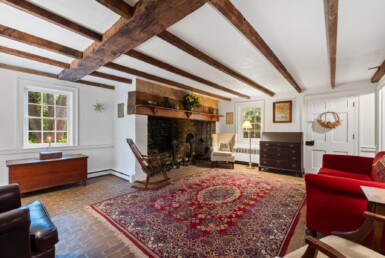
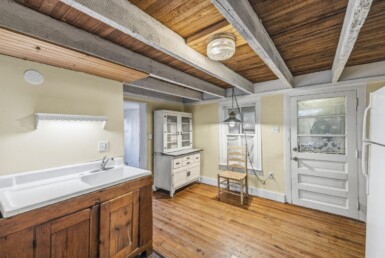
It happens when a prybar catches the lip of a yellowed piece of drywall, or when a grid of dropped ceiling tiles comes down with a clatter of dust and wire. Behind the modern, sterile surfaces that mid-century updates so casually introduced, you don’t just find structural framing—you find shadow and grain, the bite marks of a broadaxe, and timber harvested centuries ago.
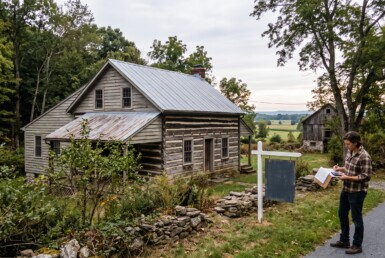
Across small towns and historic districts, thousands of early homes sit quietly wrapped in layers of vinyl siding, cheap paneling, and drop ceilings. To the untrained eye, or to a developer calculating cost per square foot, these buildings often look like prime candidates for demolition. They appear tired, dated, and structurally obsolete.
But bringing in the wrecking ball is almost always a failure of imagination. Before we write off these understated structures, it pays to consider what we lose when we demolish them—and what we gain when we choose to peel back the layers instead.
1. The Lost Forest: Materials We Can Never Buy Again
To understand the value of an early log or heavy-timber home, you have to understand the timber itself.
When early builders felled trees to build a home, they were working with old-growth forests—trees that had grown slowly over hundreds of years in dense, shaded canopies. The resulting wood was incredibly dense, packed with tight annual rings, natural resins, and structural strength that far surpasses modern, farm-raised dimensional lumber.
When a historic log home is demolished, those hand-hewn timbers—dense, naturally rot-resistant, and rich with character—are crushed and sent to a landfill. They cannot be re-ordered from a lumber yard. They cannot be grown on a modern timber plantation. Once lost, that wood is gone forever.
Restoring a timber or log structure isn’t just an aesthetic choice; it’s the stewardship of an irreplaceable natural resource.
2. The Greenest Building Is the One Already Built
In contemporary design discussions, “sustainability” often centers on solar panels, high-efficiency HVAC systems, and eco-friendly smart home devices. But true sustainability begins long before those systems are installed.
Architect and preservationist Carl Elefante famously coined the phrase: “The greenest building is one that is already built.”
Every historic building represents a massive investment of embodied energy—the energy expended to harvest raw materials, process them, transport them to the site, and assemble the structure by hand. When we demolish a building, that energy is completely wasted, while the energy footprint required to manufacture, transport, and assemble a new structure begins from zero.
Historic Restoration
Reuses existing framing, foundation, and embodied energy.
Keeps carbon locked in place; minimizes landfill waste and raw material input.
Demolition & New Build
Requires complete destruction and new material manufacturing/transport.
Generates tons of landfill waste; high energy consumption to produce new materials.
By peeling away non-historic cladding and preserving the sound core of an early building, we honor the carbon already locked inside its walls while retrofitting the home to modern efficiency standards.
3. The Art of Unmasking
One of the greatest misconceptions in historic renovation is that restoring an old house requires building everything from scratch. In reality, historic preservation is often an exercise in subtraction rather than addition.
Decades of well-intentioned updates often masked original features rather than destroying them:
- Drop Ceilings: Frequently installed to lower heating costs or hide upper-floor plumbing, these lightweight grids often conceal original joists, hand-hewn beams, or beadboard ceilings with generous height.
- Drywall and Paneling: Applied over original log walls or stone masonry to create “smooth” modern surfaces, layering wallboard unintentionally preserved the historic fabric beneath from direct wear and light damage.
- Synthetic Siding: Covered original clapboards or log chinking, protecting core timbers from decades of weather exposure.
When a property possesses a sound, plumb foundation and a tight roof line, uncovering its original story is often a matter of careful demounting—stripping away non-historic finishes to let the building breathe again.
4. Authenticity, Provenance, and the Soul of Place
In an era dominated by cookie-cutter modern developments and standardized finishes, authentic architectural character has become rare currency.
A modern build can be constructed anywhere, but a restored historic home retains a sense of narrative provenance that simply cannot be manufactured. It carries the weight of local history—connecting a neighborhood to its agricultural roots, historic trade routes, or early settlement patterns.
When buyers evaluate historic homes, they aren’t looking for perfection; they are looking for authenticity. Exposed log interiors, warm timber beams, and hand-worked surfaces create a tactile connection to the human hand that built them.
The Reveal
Demolition is permanent. Once a structure is reduced to rubble, its stories, old-growth timber, and historical context are lost to time.
Before bringing down the hammer on an older, understated property, take a closer look. Peer into the attic crawlspace; lift a tile in the drop ceiling; inspect the foundation. More often than not, behind the plain exterior lies a remarkable, enduring piece of craftsmanship just waiting for its reveal.