The Funeral Door: How Historic Homes Carried the Stories of Life and Loss
The stories shared by historic homeowners during the selling process are invaluable—a rich tapestry of narratives passed down from one generation of stewards to the next, preserving the human history embedded within these walls.
When late October turns the Mid-Atlantic light low and golden, the ancient timber, fieldstone, and historic brick of our region seem to settle into themselves. Autumn has a way of stripping back the noise, inviting us to look closer at the quiet, physical details of the homes that have stood for two hundred years.
Modern eyes often look at old houses through a lens of romance or, come October, seasonal spookiness. We decorate porches with cornstalks and jack-o’-lanterns, treating the past as a theatrical backdrop. But if you spend enough time listening to what an early house has to say, you discover that the relationship our ancestors had with life, death, and memory was far simpler, more practical, and infinitely more profound than any ghost story.
In the 18th and 19th centuries, the home was not just a sanctuary from the world; it was the stage for every milestone of human existence. People were born in the upstairs bedrooms, married in the front rooms, and cared for in their final hours beneath the same roof.
To understand an early home is to understand that death was not banished to institutional corridors. It was a domestic reality, and the architecture of the house adapted around it.
“A historic home was built for the full arc of living—a quiet vessel
that held the quietest winters, the brightest springs, and the deep,
enduring memory of those who walked its floors before us.”
The Cold Earth: Winter, Root Cellars, and the Waiting Spring
A number of years ago, while walking a historic property with a family who was preparing to pass stewardship of their ancestral home to its next caretakers, I was told a story that has stayed with me ever since.
In the mid-19th century, the matriarch of the family passed away in the depths of a brutal winter freeze. Outside, the ground was frozen solid—a stubborn layer of impenetrable ice and topsoil that made digging a six-foot grave impossible with hand tools.
Without modern morgues or municipal facilities, the family did the only dignified, practical thing they could: they carefully carried her down into the unheated stone root cellar beneath the main house.
Built into the cool earth with thick fieldstone walls, the root cellar maintained a steady temperature just above freezing. There, alongside stored apples, preserves, and winter root crops, she rested through January, February, and March. When the spring thaw finally softened the earth in April, the family gathered in the churchyard to give her a proper burial in sacred ground.
To modern sensibilities, keeping a loved one in the cellar for three months might sound unsettling. But to a farm family in 1850, it was an act of profound care, patience, and seasonal reverence. The earth that sustained them in life provided the natural cold storage to protect their mother until the earth could receive her in death.
Reading the Architecture: The Parlor and the “Funeral Door”
That same home featured a parlor with a dedicated side door—a unique architectural detail I first encountered early in my career, which opened my eyes to the deep connection between our ancestors’ daily lives and the layout of their homes.
Step across the threshold of a fine 18th- or 19th-century home, and you will often find architectural footprints specifically designed around home wakes and viewings.
Perhaps the most poignant of these features is the side entry—traditionally known in vernacular folklore as the “funeral door.”
In many historic floor plans, this second exterior door opened directly into the formal front parlor or a central passage, bypassing the daily family entrance entirely.
Front porches and main entryways were often built with tight turns, decorative trim, or narrow staircases that made maneuvering a heavy wood casket physically treacherous. A wide side door provided a straight, level egress out to the farm wagon or hearse.
Custom and local folklore dictated that a deceased family member should always leave the house feet-first. Removing the casket through a dedicated side door ensured the spirit wouldn’t “look back” through the main front door, allowing the household to move forward while honoring the departed.
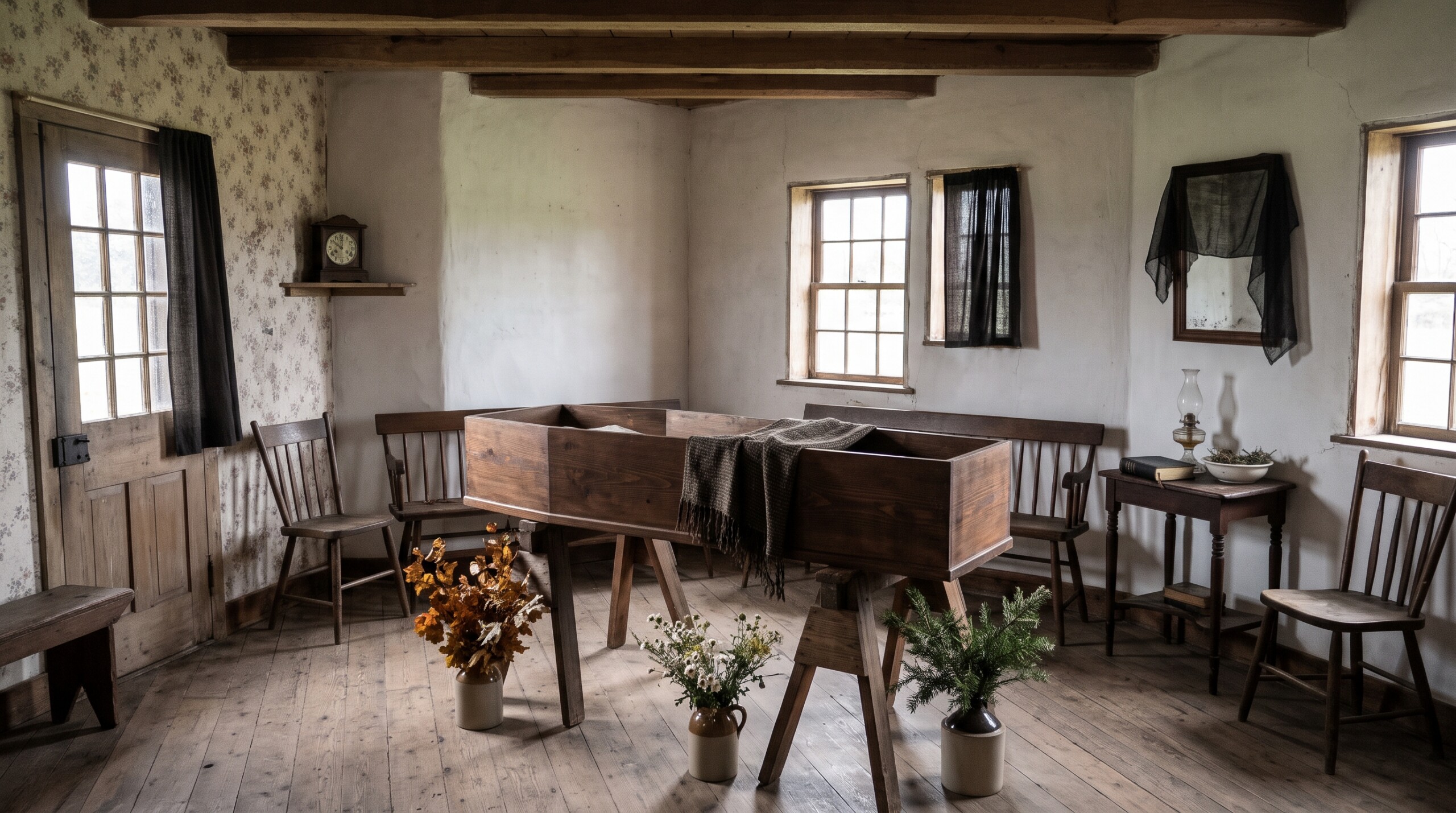
Inside, the formal parlor was the home’s official sanctuary. When a death occurred, the parlor transitioned instantly into a solemn chamber of remembrance.
The mirrors were veiled in black crepe so the living would not be distracted by vanity—or, as folk belief held, to keep the soul from becoming trapped in the reflection. Clocks were stopped at the precise minute of passing to signal that time had paused for the household. Saucer dishes of camphor rested discreetly near the casket, and black ribbon hung from the front knocker to tell passing neighbors to tread lightly.
From “Parlor” to “Living Room”
As the 20th century dawned, commercial funeral directors and dedicated parlors began taking these solemn duties away from the family home.
When the formal front parlor was finally relieved of its role as the chamber for viewing the dead, architectural trade journals and shelter magazines began urging homeowners to reimagine the space. They suggested shedding the heavy drapes, opening the windows to sunlight, and renaming the room entirely.
It was during this era that the parlor became what we know today as the “living room”—a space dedicated explicitly to the vibrant, ongoing life of the family.
Honoring the Full Story of Home
When we preserve an early house, we are doing far more than restoring heart pine floors, repointing stone foundations, or preserving vintage glass. We are keeping faith with the human experience that took place within those walls.
Halloween will always bring its lighthearted ghost stories, and there is joy in the seasonal celebration. But true historical preservation asks us to look deeper—to appreciate that the real magic of a historic home isn’t found in fictional spirits, but in the authentic, quiet resilience of the people who lived, loved, grieved, and built a legacy there.
The next time you walk past an early stone or timber house with a side door off the parlor, take a moment to look at the craftsmanship. Remember the winters, the spring thaws, and the generations who kept the porch light on—ensuring that every chapter of the human story had a place to rest.